When to use the root test. Is this not a good situation to use it?
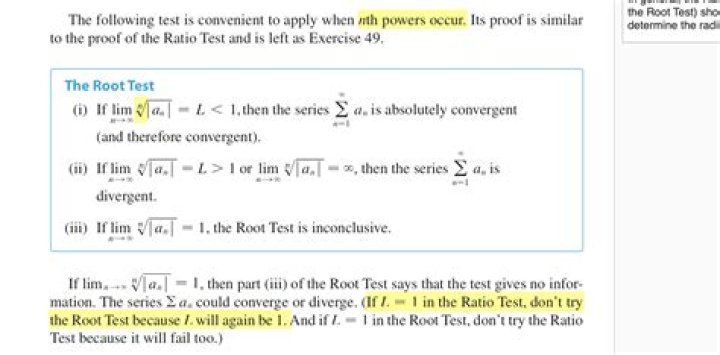
I'm having trouble seeing when to use the root test. nth powers occur, but I think the ratio test is easier:
Here is the problem:
$$\sum_{n=1}^{\infty} \frac{x^n}{n^44^n}$$
So the ratio test seems to work here, but can't the root test be used to? The problem is that the $n^4$ doesnt play well with the root test right?
Here is the beginning of my solution with the ratio test:
$$\biggr \lbrack \frac{a_{n+1}}{a_n} \biggr \rbrack = \biggr \lbrack \frac{x^{n+1}}{(n+1)^4 * 4^{n+1}} * \frac{n^4*4^n}{x^n} \biggr \rbrack = \biggr \lbrack \frac{x*n^4}{(n+1)^4 * 4} \biggr \rbrack = \frac{x}{4}$$
So I don't think the explanation for when to use the root test is totally right right? I can't really use it here because the $n^4$ causes some problems with the root test right?
$\endgroup$2 Answers
$\begingroup$It doesn't cause any problems, because $\lim_{n\to\infty}\sqrt[n]{n^4}=1.$ Actually, the root test is stronger than the ratio test. Sometimes the root test limit exists, but the ratio test limit does not. However, if they both exist, then they are equal. Which is why if one limit is $1$ you shouldn't try the other, even though the root test is stronger.
$\endgroup$ $\begingroup$When doing a root test, powers of $n$ can be ignored because, for any fixed $k$,
$\lim_{n \to \infty} (n^k)^{1/n} =1 $.
This is because$ (n^k)^{1/n} =n^{k/n} =e^{k \ln(n)/n} $and$\lim_{n \to \infty} \frac{\ln(n)}{n} =0$.
An easy, but nonelementary proof of this is this:
$\begin{array}\\ \ln(n) &=\int_1^n \dfrac{dt}{t}\\ &<\int_1^n \dfrac{dt}{t^{1/2}}\\ &=2t^{1/2}|_1^n\\ &\lt 2\sqrt{n}\\ \text{so}\\ \dfrac{\ln(n)}{n} &<\dfrac{2}{\sqrt{n}}\\ \end{array} $
Therefore$ (n^k)^{1/n} =n^{k/n} =e^{k \ln(n)/n} \lt e^{2k/\sqrt{n}} \to 1 $.
$\endgroup$