Vector equation of intersection between two planes
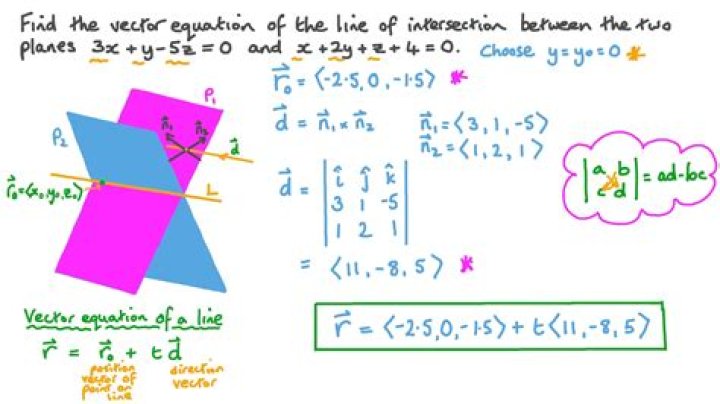
Consider two planes $\vec{r} \cdot \vec{n_{1}}=d_{1}\tag i$$\vec{r} \cdot \vec{n_2}=d_{2}.\tag {ii}$
We know that their line of intersection's direction vector is pointing in the direction of the cross product of their normals, so we get its equation to be of the form $$\vec{r}=\vec{a}+\lambda(\vec{n_1} \times \vec{n_2}),$$ where $\vec{a}$ is a point on the intersection line.
Is it possible to get the point by using (i) and (ii)?
$\endgroup$ 22 Answers
$\begingroup$Yes, you could convert equation (i) to parametric vector form, substitute it into (ii), make one parameter the subject, substitute it back into that parametric vector equation to finally obtain the intersection line's parametric vector equation. Notice that this doesn't actually involve finding $\vec a,$ which can be determined as the next step.
A more direct method (also not requiring finding $\vec a)$ is illustrated by this example: \begin{gather}\vec{r} \cdot \begin{pmatrix} 7\cr2 \cr -3\end{pmatrix}=4 \tag{$\pi_1$}\\\vec{r} \cdot \begin{pmatrix} 2\cr1 \cr 0\end{pmatrix}=5\tag{$\pi_2$} \end{gather}
$\pi_1:\;7x+2y-3z=4\\\pi_2:\;2x+y=5$
Expressing $x$ and $y$ in terms of $z$ $(\pi_1{-}2\pi_2,\,\ldots)$ gives the intersection line of $\pi_1$ and $\pi_2: \\\vec r=\begin{pmatrix} x\cr y \cr z\end{pmatrix}\\=\begin{pmatrix} z-2\cr 9-2z \cr z\end{pmatrix}\\=\begin{pmatrix} -2\cr 9 \cr 0\end{pmatrix}+z\begin{pmatrix} 1 \cr -2 \cr 1\end{pmatrix}\quad\left(z\in\mathbb R\right).$
$\endgroup$ 0 $\begingroup$Since they ask for intersection, we know that $\vec n_1$ and $\vec n_2$ are not parallel. Then $\vec n_1$, $\vec n_2$, and $\vec n_1\times \vec n_2$ are independent, so they form a basis of $\mathbb R^3$. Then we can write$$\vec a=\alpha\vec n_1+\beta\vec n_2+\gamma\vec n_1\times\vec n_2$$For simplicity, we assume that $\vec a$ has no component along the cross product direction, so the last term has $\gamma=0$. Now take this form for $\vec a$, plug it into $\vec r$ and then into the first two equations. Using the fact that $|\vec n_1|=|\vec n_2|=1$ and $\vec n_1\cdot(\vec n_1\times\vec n_2)=0$, you get $$\alpha+\beta \vec n_1\cdot\vec n_2=d_1\\\alpha\vec n_1\cdot\vec n_2+\beta=d_2$$Get $\alpha$ and $\beta$ and plug it into the formula for $\vec a$.
$\endgroup$ 3