Relation among the diagonals of a regular heptagon
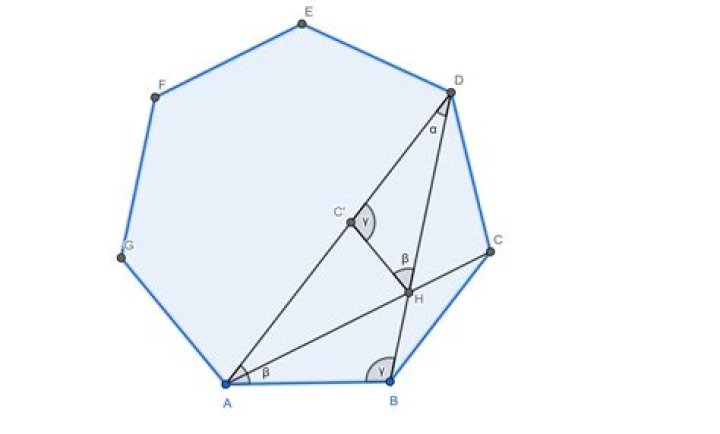
The question is about this problem (it is from a Math' Olympiad in Germany):
Prove that if a regular heptagon $ABCDEFG$ has side 1, then
$$\frac1{AC}+\frac1{AD}=1$$
I have found something: using the law of cosines I have derived a third degree equation that is satisfied if the statement is true, but this solution is long and ugly, and, in fact, it is not a solution since the equation has two more roots. I can search for my notes if anybody would need details.
In fact, I'm looking for a less algebraic kind of solution :-)
$\endgroup$3 Answers
$\begingroup$You can apply Ptolemy's theorem to quadrilateral $ACDE$: $$\color{red}{AC} \cdot DE + CD \cdot \color{blue}{AE} = \color{green}{AD} \cdot \color{magenta}{CE}.$$
By symmetry $DE = CD = 1$, $AE = AD$, $CE = AC$.
So
$$\begin{align}
\color{red}{AC} + \color{blue}{AD} &= \color{green}{AD} \cdot \color{magenta}{AC},\\
\frac{1}{AD} + \frac{1}{AC} &= 1.
\end{align}$$
My first thought is to place the vertices in the complex plane in the standard way: let $\zeta_7 = e^{2 \pi i/7}$ be a primitive $7^{\rm th}$ root of unity, and let $A = \zeta_7^0 = 1$, $B = \zeta_7$, $C = \zeta_7^2$, etc. Then the claim to be proven is equivalent to $$\frac{1}{|\zeta_7^2 - 1|} + \frac{1}{|\zeta_7^3 - 1|} = \frac{1}{|\zeta_7 - 1|}.$$ Then using the fact that $|z|^2 = z\bar z$ for any complex number $z$, $\bar \zeta_7 = \zeta_7^{-1}$, $\zeta_7^{7+k} = \zeta_7^k$, and $\sum_{k=0}^6 \zeta_7^k = 0$, you should be able to verify this identity.
$\endgroup$ $\begingroup$Here is a proof with just similarity between triangles. First consider the notations as in the figure down below
We define the angles $\alpha,\beta,\gamma$ as such$$\gamma=2\beta=4\alpha=\frac{4\pi}{7}$$Indeed they appear as the angles of the arc supported by $4,2$ and $1$ side of the heptagon. Set $H$ the intersection of the two diagonals $AC$ and $BD$, as well as $C'$ the symetric image of $C$ about $(BD)$. Since $\widehat{ADB}=\widehat{BDC}$, the point $C'$ lies on $AD$. Thus$$DC=DC'.$$
The triangle $AHC'$ is isosceles in $A$, since the its angles are $\alpha,3\alpha,3\alpha$. So$$AH=AC'.$$
Thus$$AB+DH=DC+DH=DC'+AH=DC'+AC'=AD.$$
Dividing by $AB\cdot AD$ we get$$\frac{1}{AD}+\frac{DH}{AB\cdot AD}=\frac{1}{AB}.$$
Now the triangles $\Delta DHC'$ and $\Delta DAB$ are similar, so$$\frac{DH}{DA}=\frac{DC'}{DB}$$
in other words$$\frac{DH}{AB\cdot AD}=\frac{DH}{DA\cdot DC'}=\frac{1}{DB}=\frac{1}{AC}.$$
So we have shown that in a regular heptagon $ABCDEFG$$$\frac{1}{AD}+\frac{1}{AC}=\frac{1}{AB}.$$
$\endgroup$