Proving the convergence of the $p$-series without using the integral test? [duplicate]
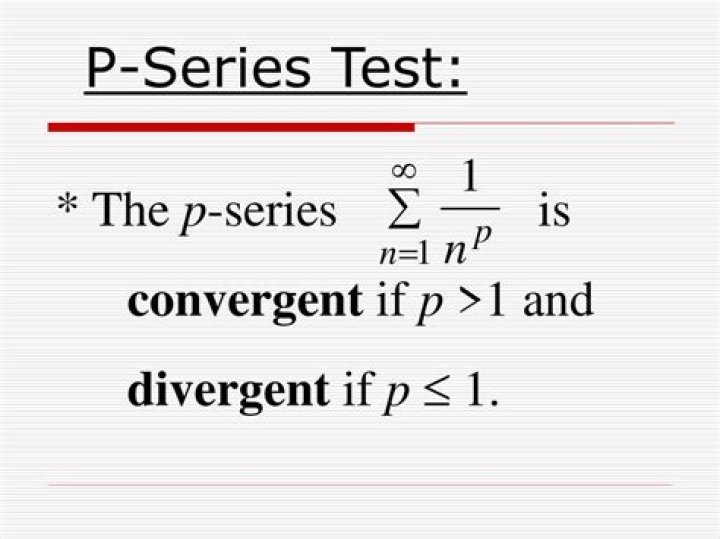
I'm having trouble figuring out how to prove the convergence of the $p$-series, that is,
$$\sum_{n=1}^{\infty}{\frac{1}{n^p}}$$
where $p > 1$.
I'm in a real analysis course and I have a midterm coming up. I think I might need to prove this on the midterm, but without using the integral test. I appreciate any help. Thanks in advance.
$\endgroup$ 44 Answers
$\begingroup$The sum from $n=2^k$ to $n=2^{k+1}-1$ is at most the number $2^k$ of terms times the largest term $1/2^{pk}$. Since $r=2^{1-p}\lt1$, the sum of the series is at most $$ \sum_{n\geqslant1}\frac1{n^p}\leqslant\sum_{k\geqslant0}\frac{2^k}{2^{pk}}=\sum_{k\geqslant0}r^k=\frac1{1-r}=\frac1{1-2^{1-p}}. $$
$\endgroup$ 3 $\begingroup$Hint
We have for $p\ne0$
$$\frac{1}{n^{p}}-\frac{1}{(n+1)^{p}}=\frac{1}{n^{p}}\left(1-\left(1+\frac{1}{n}\right)^{-p}\right)\sim \frac{p}{n^{p+1}}$$ and use telescoping sum.
$\endgroup$ $\begingroup$If $p>2$, then $\displaystyle\sum_1\frac1{n^p}<\sum_1\frac1{n^2}<1+\sum_2\frac1{n(n-1)}=2$. So the question now remains how to prove its convergence for $p\in(1,2)$.
$\endgroup$ $\begingroup$Prove that the partial sum from 1 to $2^N-1$ is bounded gruoping $$a_1+(a_2+a_3)+(a_4+\cdots+a_7)+\cdots$$ and bounding with the sum of a geometric progression.
$\endgroup$