On Changing The Direction Of The Inequality Sign By Dividing By A Negative Number?
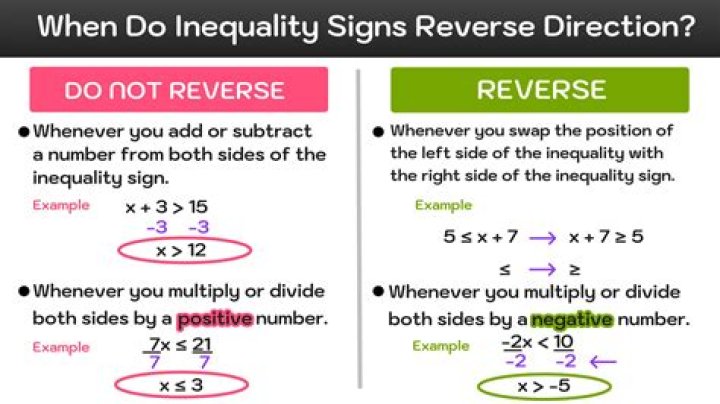
When solving inequality equations, we have to change the sign of the inequality when we divide/multiply by a negative number. And I get why. Because your making one side positive and one side negative.
But let's say you were multiplying by say $(x^3+1)/x>1$ or something. When you multiply both sides by x, why don't you need to flip the sign? Because there's the possibility x is negative! Why don't you need to construct to equations, one where the sign is the same, and one where the sign is flipped.
As an extension, let's say you were multiplying both sides of $(x^3+1)/-x>1$ by -x. Do you need to change the sign too?
Thank you in advance.
$\endgroup$ 42 Answers
$\begingroup$Note that there is not exception and the following
$$\frac{x^3+1}{x}>1 \iff x^3+1>x$$
holds for $x>0$ while for $x<0$ we have
$$\frac{x^3+1}{x}>1 \iff x^3+1<x$$
To avoid this kind of manipulation and distinction in two cases, we can proceed, as an alternative, as follow
$$\frac{x^3+1}{x}>1 \iff \frac{x^3+1}{x}-1>0 \iff \frac{x^3+1-x}{x}>0$$
and consider separetely the sign of numerator and denominator.
$\endgroup$ $\begingroup$When you multiply the sides by $x$, you don't need to flip the sign if you assume that $x>0$. If you assume that $x<0$, then you do have to flip the sign.
In general, when solving the inequality $$\frac{x^3+1}{x} > 1$$ you must separate two cases:
- If $x>0$, then the inequality is equivalent to $x^3+1 > x$
- If $x<0$, then the inequality is equivalent to $x^3+1<x$