Inverse Relation (Definition)
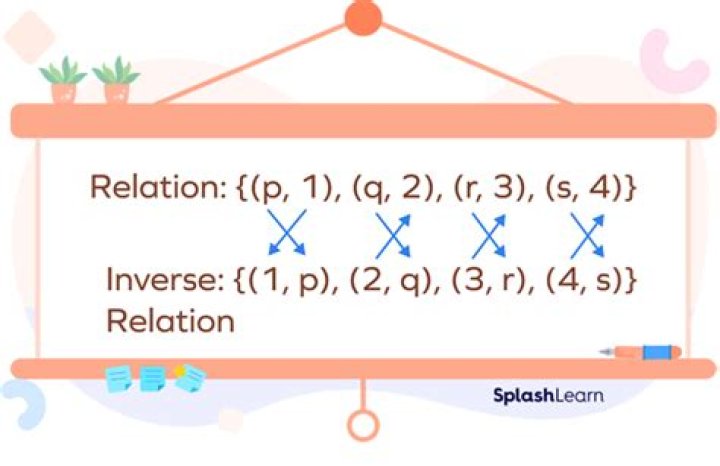
In the book Advanced Calculus by Shlomo and Sternberg (Chapter 0, Section 6), the inverse of an relation is defined as follows:
"The inverse $ R^{-1} $, of a relation R is the set of ordered pairs obtained by reversing those of R:
$$ R^{-1} = \{\langle x,y\rangle\, |\,\langle y,x\rangle \in R\ \} $$ "
It seems that this definition does not actually reverse all the ordered pairs in R, or am I wrong?
$\endgroup$ 32 Answers
$\begingroup$Take, as an example, the relation $R$ on $\mathbb{R}$, defined by $(x,y) \in R$ iff $x \leq y$. That is, $R = \{ (x,y) ~|~ x \leq y \}$, so $(1,2) \in R$, but $(5,2) \notin R$. Then the a pair $(x,y)$ satisfies the inverse relation, i.e. $(x,y) \in R^{-1}$, iff $(y,x) \in R$. In our example this means that $$ (x,y) \in R^{-1} \Leftrightarrow (y,x) \in R \Leftrightarrow y \leq x \Leftrightarrow x \geq y. $$ For example, the element $(5,2)$ which did not satisfy $R$, now satisfies $R^{-1}$ because $(2,5) \in R$. Thus the relation "$\geq$" is the inverse relation of "$\leq$", which makes sense.
So the definition looks about right, don't you agree?
$\endgroup$ 4 $\begingroup$The definition might be easier to understand when it is written like this:
the inverse relation of R = { pairs (y,x) | the pair (x,y) belongs to R }
That is the way it is phrased in Lipschutz, Schaum's Outline of Set Theory ( Chapter 6) ( available at Archive.org).
I think this manner of defining " inverse relation" makes more explicit the fact that the inverse relation of R is simply the set of all the " inverse pairs" of the pairs belonging to R.
$\endgroup$