How do you find appropriate trig substitution for $\int \frac{\sqrt{16x^2 - 9}}{x} \, dx$?
I want to solve the below:
$$\int \frac{\sqrt{16x^2 - 9}}{x} \, dx$$
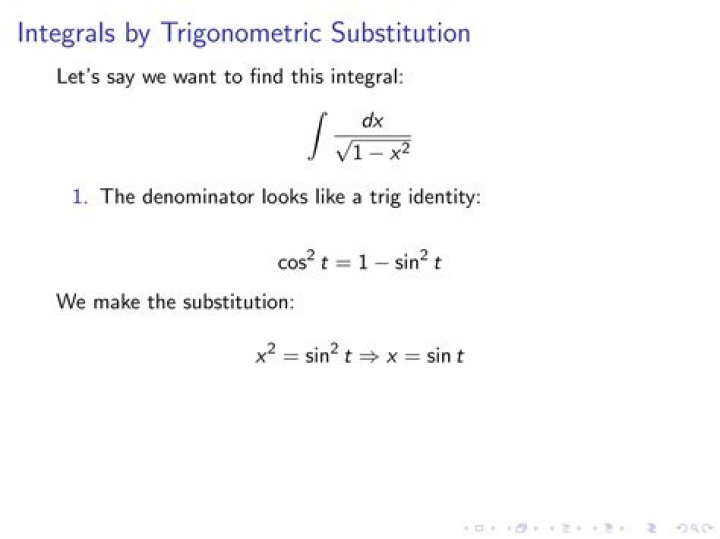
I know for trig substitution, if I have something in the form of $\sqrt{x^2-a^2}$, I can use $x = a\sec{u}$; it just so happens my integral has a numerator in this form: $\sqrt{16x^2 - 3^2}$ so I know to use $x = 3\sec u$:
$$ \begin{align} & \int \frac{\sqrt{16x^2 - 9}}{x} \, dx \\ = {} & \int \frac{\sqrt{16x^2 - 3^2}}{x} \, dx \\ = {} & \int \frac{\sqrt{16(3\sec u)^2 - 3^2}}{3\sec u} 3\sec u\tan u \, du \\ = {} & \int \frac{(\sqrt{16(3\sec u)^2 - 3^2)}(3\sec u\tan u)}{3\sec u} \, du \\ = {} & \int \sqrt{(16(3\sec u)^2 - 3^2)}(\tan u) \, du \end{align} $$
This doesn't seem to make it easy. However, using a calculator online, it suggests I instead use $x = \dfrac{3}{4}\sec{u}$ which simplifies the integral to a crisp $\int 3\tan^2 u \, du$.
My question is, how did the calculator get $a = \dfrac{3}{4}$ and is there a way to determine an ideal trig substitution for a given function?
$\endgroup$ 89 Answers
$\begingroup$In general, if you have $\sqrt{p x^2\pm q}$
- Make the coefficient $x$ equal to $1$ by taking coefficient of $x^2$ out of square root which gives $$\sqrt{px^2\pm q}=\sqrt p\sqrt{x^2\pm \frac{q}{p}}$$
Above expression: $\sqrt{x^2\pm \frac{q}{p}}$ can be changed into the form: $\sqrt{x^2\pm a^2}$ by equating $a=\sqrt{\dfrac{q}{p}}$
Substitute $x=a\sec u$ for the form $\sqrt{x^2-a^2}$ and $x=a\tan u$ for the form $\sqrt{x^2+a^2}$
For this case: $$\sqrt{16x^2-9}=\sqrt{16}\sqrt{x^2-\frac{9}{16}}$$ $$\sqrt{x^2-a^2}=\sqrt{x^2-\frac{9}{16}}$$$$\implies a=\sqrt{\frac{9}{16}}=\frac34$$
$\endgroup$ $\begingroup$Note: $\sqrt{16x^2-3^2}$ is a difference of squares. Draw a picture of a right triangle suggested by this: $4x$ the hypotenuse, $3$ one of the legs (say the side opposite angle $\theta$), and $\sqrt{16x^2-3^2}$ the side adjacent to angle $\theta$.
Do it, don't just rely on my description.
So then:$$ \sin\theta = \frac{3}{4x}, \\ \cos\theta = \frac{\sqrt{16x^2-3^2}}{4x}, \\ \tan\theta = \frac{3}{\sqrt{16x^2-3^2}}. $$Use the simplest one to suggest the substitution:$$ x = \frac{3}{4}\csc \theta, \\ dx = -\frac{3}{4}\csc\theta\cot\theta\;d\theta $$Then substitute back into your integral, looking at your picture to find how to move between $x$ and $\theta$. Here$$ \frac{\sqrt{16x^2 - 9}}{x} = 4\cos \theta $$so we get\begin{align} \int\frac{\sqrt{16x^2 - 9}}{x}\;dx &= -\int 4\cos \theta \frac{3}{4}\csc\theta\cot\theta\;d\theta \\ &= -3\int\frac{\cos^2\theta}{\sin^2\theta}\;d\theta = 3\big(\cot \theta + \theta\big)+C \end{align}and then look at the picture to get$$ 3\big(\cot \theta + \theta\big)+C= 3 \left[\frac{\sqrt{16x^2-3^2}}{3} + \arcsin\frac{3}{4x}\right]+C $$
this method also works for "sum of squares". Draw the right triangle suggested by that particular sum of squares.
$\endgroup$ $\begingroup$$$ 16x^2 - 9 = 9\left( \left( \tfrac{4x}{3} \right)^2 - 1 \right) = 9(\sec^2\theta - 1) = 9\tan^2\theta. $$
$\endgroup$ $\begingroup$I am confused by the suggestion to use trigonometric substitution, since $$\frac{\sqrt{16x^2 - 9}}{x} = 16 x \frac{\sqrt{16x^2 - 9}}{16x^2},$$ and the substitution $$u^2 = 16x^2 - 9, \quad 2u \, du = 32 x \, dx$$ yields $$\begin{align*} \int \frac{\sqrt{16x^2 - 9}}{x} \, dx &= \int \frac{u}{u^2 + 9} u \, du \\ &= \int 1 - \frac{9}{u^2 + 9} \, du \\ &= u - 3 \tan^{-1} \frac{u}{3} + C \\ &= \sqrt{16x^2 - 9} - 3 \tan^{-1} \frac{\sqrt{16x^2 - 9}}{3} + C. \end{align*}$$Trigonometric substitution certainly works, but in such cases, we can certainly avoid it.
$\endgroup$ $\begingroup$Substitute $\sec t= \frac43 x$ to integrate
$$\int \frac{\sqrt{16x^2 - 9}}{x} dx= 3\int \tan^2tdt= 3\int( \sec^2t -1)dt = 3\tan t -3t+C $$
$\endgroup$ $\begingroup$For such radicals, I find the hyperbolic substitution easier.
With $\dfrac43x=\cosh t$,
$$\int\frac{\sqrt{16x^2-9}}xdx=3\int\frac{\sqrt{\dfrac{16}9x^2-1}}xdx=3\int\frac{\sinh^2t}{\cosh t}dt=3\int\frac{dt}{\cosh t}+3\int\cosh t\,dt.$$
$\endgroup$ $\begingroup$Given $\int \frac{\sqrt{16x^2}-9}{x}dx$ and that $\sqrt{x^2-a^2} \Rightarrow x=a \sec \theta \wedge a \sec \theta \tan \theta d\theta =dx$
Then,
$$\int \frac{\sqrt{16x^2}-9}{x}dx \Rightarrow \int \frac{\sqrt{16(3 \sec\theta)^2}-3^2}{3 \sec \theta} 3 \sec \theta \tan \theta d\theta $$
$$ = 12\int \tan \theta \sqrt{\sec^2 \theta}-9 $$$$ = 12\sqrt {\sec^2\theta} -81\theta +C$$
by factoring out constants and integrating the sum term by term.
$\endgroup$ $\begingroup$First get rid of the annoying factors,
$$\int\frac{\sqrt{16x^2-9}}xdx=\int\frac{\sqrt{16\left(\dfrac{3y}4\right)^2-9}}{\dfrac{3y}4}d\dfrac{3y}4=3\int\frac{\sqrt{y^2-1}}{y}dy.$$
Then observe the identity
$$\left(\frac 12\left(t+\dfrac1t\right)\right)^2-1=\left(\frac 12\left(t-\dfrac1t\right)\right)^2.$$
Then with $y=\dfrac 12\left(t+\dfrac1t\right)$ and $dy=\dfrac 12\left(1-\dfrac1{t^2}\right)$,
$$\int\frac{\sqrt{y^2-1}}{y}dy=\int\frac{\dfrac 12\left(t-\dfrac1t\right)}{\dfrac 12\left(t+\dfrac1t\right)}\dfrac 12\left(1-\dfrac1{t^2}\right)dt=\frac12\int\left(1+\frac1{t^2}-\frac{4}{t^2+1}\right) dt$$
which is easy.
$\endgroup$ $\begingroup$For this problem, you goal with trig substitution to convert the radical into $\sqrt{a(\sec^2 x-1)}$ which equals $\tan x \cdot \sqrt{a}$.
Therefore, let $x=\dfrac{3\sec u}{4}$ so that when $x$ is squared in the radical, you're left with $\sqrt{9\left(\sec^2 u-1\right)}$.
$\endgroup$ 1