Finding lines of symmetry algebraically
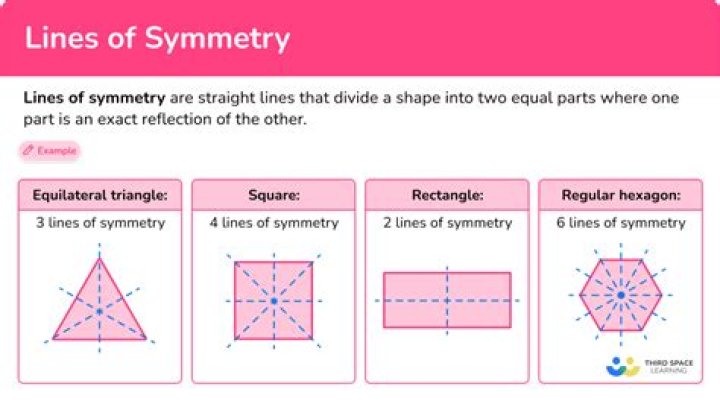
How would you determine the lines of symmetry of the curve $y=f(x)$ without sketching the curve itself?
I was working on the problem of finding the lines of symmetry of the curve given by:
$ x^{4}$+$ y^{4}$ = $u$ where u is a positive real number.
but I had to resort to doing a quick sketch.
Is there an explicit condition for a line to be considered a line of symmetry of a curve?
Thanks.
$\endgroup$ 54 Answers
$\begingroup$If you are able to determine the center of gravity of the region enclosed by the curve, any line of symmetry has to go through that. If that center is $(s,t)$, then you should only consider lines of the form $$ a(x-s)+b(y-t)=0 $$
For your example, clearly $x^4+y^4=u$ for constant $u$ has center of mass $(0,0)$, so you should only consider lines of the form $$ ax+by=0 $$
$\endgroup$ $\begingroup$The line $x=0$ is a symmetry line, because if a point $P=(x_1,y_1)$ fulfills the equation, then $(-x_1,y_1)$ ($P$ reflected about the $y$-axis) does too.
Similarly, if $Q=(x_2,y_2)$ fulfills the equation, then so does $(y_2,x_2)$, which is $Q$ reflected about the line $x=y$. Therefore that line is also a symmetry line for the curve.
There are more symmetry lines, but this is how you look for them. I think you should be able to find the other two on your own.
$\endgroup$ 2 $\begingroup$A line L given by $ax+by+c=0$ is a line of symmetry for your curve, if and only if for any point $P_1(x_1,y_1)$ from the curve, its symmetrical point $P_2(x_2,y_2)$ (with respect to the line L) is also on the curve.
Now:
(1) express $x_2$ and $y_2$ as functions of $x_1, y_1$ (this can be done from the equation of L);
(2) substitute the $x_2$ and $y_2$ expressions in the curve equation (because they should satisfy it too); thus you'll get the "iff condition" which you're looking for.
In the general case i.e. for any arbitrary curve, it won't be a nice equation, I believe.
$\endgroup$ 1 $\begingroup$By definition, G has line of symmetry $y=px+q$ if for every point $(\alpha,\beta)\in G$ , its reflection point is also in $G$ .
By the Lemma below, its reflection point is $\left(\frac{2p(\beta-q)+(1-p^{2})\alpha}{p^{2}+1},\frac{(p^{2}-1)\beta+2p\alpha+2q}{p^{2}+1}\right)$ .
Hence, a graph $G$ has line of symmetry $y=px+q$ if and only if:
$$(\alpha,\beta)\in G\implies \left(\frac{2p(\beta-q)+(1-p^{2})\alpha}{p^{2}+1},\frac{(p^{2}-1)\beta+2p\alpha+2q}{p^{2}+1}\right)$$
$\\$
$\\$
Lemma. The reflection point of $(\alpha,\beta)$ on the line $y=px+q$ is $$\left(\frac{2p(\beta-q)+(1-p^{2})\alpha}{p^{2}+1},\frac{(p^{2}-1)\beta+2p\alpha+2q}{p^{2}+1}\right)$$
Proof. Let $y=-(1/p)x+r$ be the line that is perpendicular to the line of symmetry and which runs through $(\alpha,\beta)$ . Then $\beta=-(1/p)\alpha+r \implies r=\beta+\alpha/p$.
So the equation of that perpendicular line is $y=-(1/p)x+\beta+\alpha/p$ .
The intersection point of this perpendicular line with the original line of symmetry is given by:
$$px+q= -(1/p)x+\beta+\alpha/p \\ (p+1/p)x= \beta+\alpha/p-q \\ x= \frac{p\beta+\alpha-pq}{p^{2}+1}=\frac{p(\beta-q)+\alpha}{p^{2}+1} \\ y= px+q \\ y= p\frac{p(\beta-q)+\alpha}{p^{2}+1}+q \\ y= \frac{p^{2}(\beta-q)+p\alpha+(p^{2}+1)q}{p^{2}+1} \\ y= \frac{p^{2}\beta+p\alpha+q}{p^{2}+1} $$
The reflection point is twice as far away from $(\alpha,\beta)$ as is the above intersection point. So the reflection point is:
$$\left(2\frac{p(\beta-q)+\alpha}{p^{2}+1}-\alpha,2\frac{p^{2}\beta+p\alpha+q}{p^{2}+1}-\beta\right) \\ = \left(\frac{2p(\beta-q)+2\alpha-(p^{2}+1)\alpha}{p^{2}+1},\frac{2p^{2}\beta+2p\alpha+2q-(p^{2}+1)\beta}{p^{2}+1}\right) \\ = \left(\frac{2p(\beta-q)+(1-p^{2})\alpha}{p^{2}+1},\frac{(p^{2}-1)\beta+2p\alpha+2q}{p^{2}+1}\right) \blacksquare $$
$\endgroup$