Find rank and nullity of this linear transformation.
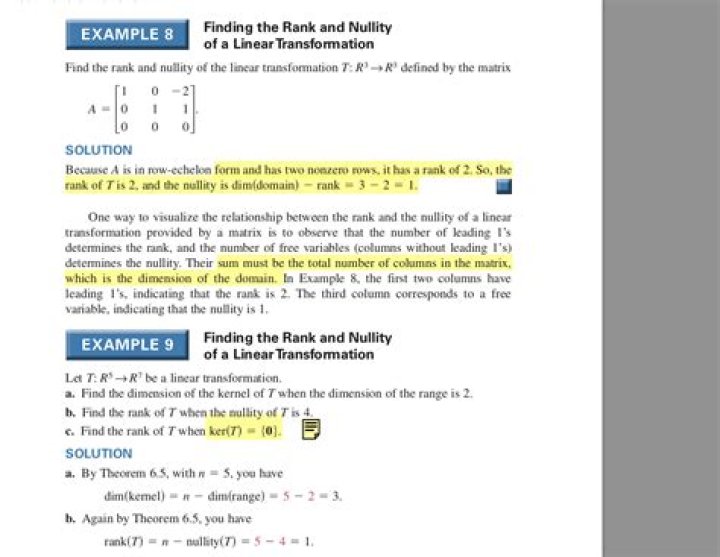
So I know how to do questions like this:
But this one is throwing me off a bit.
For the linear transformation $T\colon \mathbb{R}^3 \to \mathbb{R}^2$, where $T(x, y, z) = (x − 2y + z, 2x + y + z)$: (a) Find the rank of $T$. (b) Without finding the kernel of $T$, use the rank-nullity theorem to find the nullity of $T$
Is this right?
I think the equations represent this matrix:
\begin{bmatrix} 1 & -2 & 1 \\ 2 & 1 & 1 \end{bmatrix}
It's a 3x2 matrix which means it represents a transformation from $R^3$ to $R^2$
rank T:
\begin{bmatrix} 1 & -2 & 1 \\ 0 & 5 & -1 \end{bmatrix} \begin{bmatrix} 1 & -2 & 1 \\ 0 & 1 & \frac{-1}{5} \end{bmatrix} \begin{bmatrix} 1 & 0 & \frac{3}{5} \\ 0 & 1 & \frac{-1}{5} \end{bmatrix}
rank is 2 nullity is 1.
Conceptually did I do this right? The equations that I'm given represent equations that I can then convert into a coefficient matrix which I can use to determine the missing variables right?
$\endgroup$ 32 Answers
$\begingroup$More precisely, the matrix $$ \left( \begin{matrix} 1 & -2 & 1 \\ 2 & 1 & 1 \end{matrix} \right) $$ is the matrix associated to $T$ with respect to the standard bases of $\mathbb{R}^3$ and $\mathbb{R}^2$. Without doing reduction, the rank of $T$ is given by the rank of one of the biggest submatrices with non-vanishing determinant. In your case there is a submatrix of rank $2$ with determinant non-zero (as gimusi is showing), so the rank of $T$ is $2$.
$\endgroup$ $\begingroup$Yes your way is correct, as an alternative since
$$\det\begin{bmatrix} 1 & -2 \\ 2 & 1 \end{bmatrix}\neq 0$$
we can conclude that $\operatorname{rank}=2$ and then nullity is $3-2=1$.
$\endgroup$