Determine whether series is convergent or divergent $\sum_{n=1}^{\infty}\frac{1}{n^2+4}$
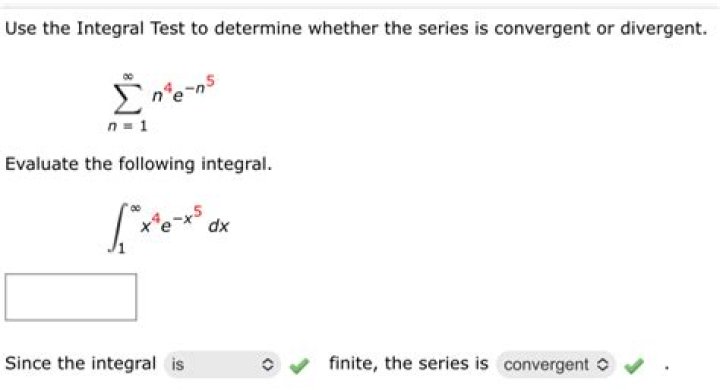
I still haven't gotten the hang of how to solve these problems, but when I first saw this one I thought partial fraction or limit. So I went with taking the limit but the solution manual shows them using the integral test.
Was I wrong to just take the limit?
$$\sum_{n=1}^{\infty}\frac{1}{n^2+4}$$
Next:
$$\lim_{n\to\infty}\frac{1}{n^2+4}=0$$
So converges by the test for divergence?
$\endgroup$ 24 Answers
$\begingroup$We only have the following statement to be true: $$\text{If $\sum_{n=1}^{\infty} a_n$ converges, then $a_n \to 0$.}$$ The converse of the above statement is not true, i.e., $$\text{if $a_n \to 0$, then $\displaystyle \sum_{n=1}^{\infty} a_n$ converges is an incorrect statement.}$$
For instance, $\displaystyle \sum_{n=1}^{\infty} \dfrac1n$ diverges, even though $\dfrac1n \to 0$.
To prove your statement, note that $\dfrac1{n^2+4} < \dfrac1{n^2}$ and make use of the fact that $\displaystyle \sum_{n=1}^{\infty} \dfrac1{n^2}$ converges to conclude that $\displaystyle \sum_{n=1}^{\infty}\dfrac1{n^2+4}$ converges.
$\endgroup$ 1 $\begingroup$Just expounding on $\frac{1}{n^2 + 4} < \frac{1}{n^2}$ in the above answer.
This holds using the Comparison Test which states that if $\sum a_n$ and $\sum b_n$ are such that $0 \le a_n \le b_n$, if $\sum b_n$ converges, then $\sum a_n$ converges.
$\endgroup$ 2 $\begingroup$Another way, that needs fewer theorems:
$n^2+4 > n(n-1)$ so $\frac1{n^2+4} < \frac1{n(n-1)} = \frac1{n-1}-\frac1{n} $.
Therefore, for any $m > 0$ $\sum_{n=2}^m \frac1{n^2+4} < \sum_{n=2}^m (\frac1{n-1}-\frac1{n}) = 1-\frac1{m} < 1 $.
Therefore $\sum_{n=2}^m \frac1{n^2+4}$ converges as $m \to \infty$.
$\endgroup$ $\begingroup$$\newcommand{\+}{^{\dagger}}% \newcommand{\angles}[1]{\left\langle #1 \right\rangle}% \newcommand{\braces}[1]{\left\lbrace #1 \right\rbrace}% \newcommand{\bracks}[1]{\left\lbrack #1 \right\rbrack}% \newcommand{\dd}{{\rm d}}% \newcommand{\isdiv}{\,\left.\right\vert\,}% \newcommand{\ds}[1]{\displaystyle{#1}}% \newcommand{\equalby}[1]{{#1 \atop {= \atop \vphantom{\huge A}}}}% \newcommand{\expo}[1]{\,{\rm e}^{#1}\,}% \newcommand{\fermi}{\,{\rm f}}% \newcommand{\floor}[1]{\,\left\lfloor #1 \right\rfloor\,}% \newcommand{\ic}{{\rm i}}% \newcommand{\imp}{\Longrightarrow}% \newcommand{\ket}[1]{\left\vert #1\right\rangle}% \newcommand{\pars}[1]{\left( #1 \right)}% \newcommand{\partiald}[3][]{\frac{\partial^{#1} #2}{\partial #3^{#1}}} \newcommand{\pp}{{\cal P}}% \newcommand{\root}[2][]{\,\sqrt[#1]{\,#2\,}\,}% \newcommand{\sech}{\,{\rm sech}}% \newcommand{\sgn}{\,{\rm sgn}}% \newcommand{\totald}[3][]{\frac{{\rm d}^{#1} #2}{{\rm d} #3^{#1}}} \newcommand{\ul}[1]{\underline{#1}}% \newcommand{\verts}[1]{\left\vert #1 \right\vert}% \newcommand{\yy}{\Longleftrightarrow}$ \begin{align} \sum_{n = 1}^{\infty}{1 \over n^{2} + 4} &= \sum_{n = 0}^{\infty}{1 \over \pars{n + 1 + 2\ic}\pars{n + 1 - 2\ic}} = {\Psi\pars{1 + 2\ic} - \Psi\pars{1 - 2\ic} \over \pars{1 + 2\ic} - \pars{1 - 2\ic}} = {1 \over 2}\,\Im\Psi\pars{1 + 2\ic} \\[3mm]&= {1 \over 2}\bracks{-\,{1 \over 4} + {1 \over 2}\,\pi\coth\pars{2\pi}} \end{align} $$ \color{#0000ff}{\large\sum_{n = 1}^{\infty}{1 \over n^{2} + 4}} = \color{#0000ff}{\large{1 \over 4}\bracks{\pi\coth\pars{2\pi} - {1 \over 2}}} \approx 0.6604 $$
$\endgroup$