"Derivation" of leibniz integral rule using chain rule
This proof assumes the leibniz integral rule with constant limits is established.
Let $g(x) = \int_{a(x)}^{b(x)} f(x,y) dy$. Then let $u = b(x), v = a(x)$.
Write $g(x,u,v) = \int_{v}^{u} f(x,y)dy$, by the chain rule, we have $g_x(x,u,v) = g_u (du/dx) + g_v (dv/dx) + \int_{v}^{u} f_x(x,y)dy = f(x,u)u'(x) -g(x,v)v'(x) + \int_{v}^{u} f_x(x,y)dy$, where the last term is obtained by treating $u,v$ as constant and applying the leibniz integral rule with constant limits.
I am not completely convinced of this proof. How exactly did the chain rule application work here? It seems like for the first two terms, we treated both $u,v$ as functions of $x$, yet the last term we treat $u,v$ as constants.
$\endgroup$1 Answer
$\begingroup$Let us write out the chain rule more explicitly:
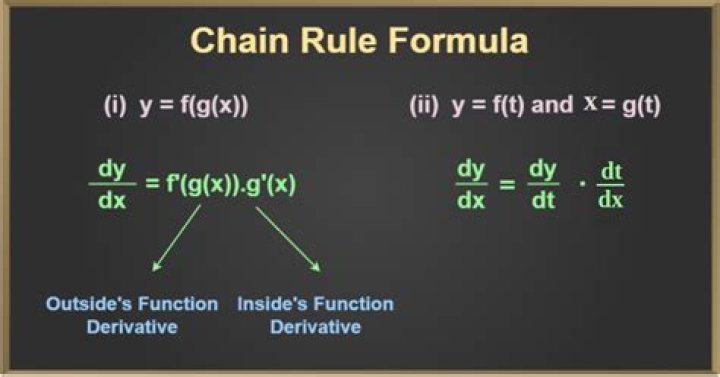
\begin{equation} \frac{dg}{dx}=\frac{\partial g}{\partial v}\frac{dv}{dx}+\frac{\partial g}{\partial u}\frac{du}{dx}+\frac{\partial g}{\partial x}\frac{dx}{dx} . \end{equation}The third term in the above sum corresponds to the third term in your original post, and by nature of the multivariable chain rule we are treating $u,v$ as constant with respect to $x$ in the third $\textit{partial}$ derivative, just as we are treating $x,v$ as constant with respect to $u$ in the second and $x,u$ as constant with respect to $v$ in the first partial derivatives above.
$\endgroup$ 2