Common symbols in linear algebra
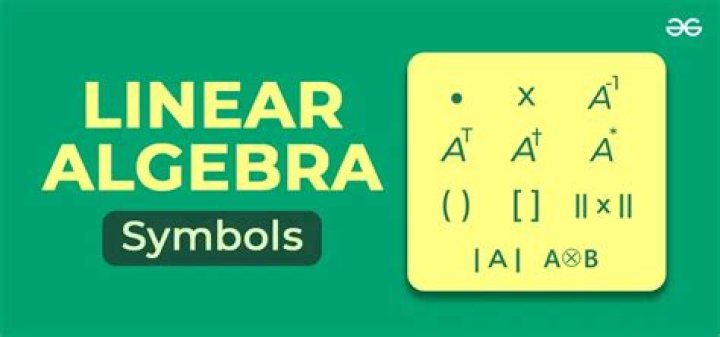
I would like to clarify what symbols are the most commonly used for the following concepts in linear algebra:
Linear transformations from $V$ to $U$, and the set of all transformations.
A $m$-by-$n$ matrix over the field $\mathbb{F}$, and the set of all matrices.
The matrix associated with a linear map $T:V \to U$.
Linear independence
Isomorphism, Canonical isomorphism. (For linear maps and vector spaces)
Linear map associated with tensor. Tensor (rank 2) associated with linear map.
2 Answers
$\begingroup$Notations I've used for these:
- $\mathcal L(U,V) = \{f:U \to V \mid f \text{ is linear}\}$. One may write $f \in \mathcal L(U,V)$. It also helps to write $\mathcal L(U):=\mathcal L(U,U)$.
- $\Bbb F^{m \times n}$, or $\mathcal M_{m \times n}(\Bbb F)$
- Note that often you'd want to specify a choice of basis here. In any case, I'd use $[T]$ to mean the matrix of $T$, and $[T]_{\mathcal A \to \mathcal B}$ to denote the matrix of $T$ with respect to the bases $\mathcal A,\mathcal B$.
- No common symbols that I know of
- $U \cong V$ or $U\sim V$ is used to indicate that the spaces are isomorphic. Sometimes $f:U \overset{\sim}{\to}V$ is used to indicate that $f$ is an isomorphism between the spaces. I don't know of a special symbol for canonical isomorphism.
- Not sure what you mean here. Perhaps you mean the map $T \otimes T$.
As linear maps are represented by matrices, and every matrix defines a map, the notation is not always clean-cut and the same family of symbols might be used by both. The following list is not supposed to be complete and just a collection from my personal experience as student and teacher.
If you want to emphasize on the property that it's a linear map, you might write $f:V\rightarrow U$, $T:V\rightarrow U$ and denot the image of a vector $v$ by $f(v)$ or $T(v)$. In particular when $U$ is either $\mathbb R$ or $\mathbb C$, you might see function-like notations.
Capital serif letters. Basically the whole alphabet. Including $T$. The identity matrix is usually denoted by $I$, but sometimes also by $E$. Depending on the name of the vector space, you won't use $H,U,V,X,Y,Z$.
There is not a single matrix associated with a map $T$, as matrices are representations w.r.t. some bases in $U$ and $V$. If $T$ is fixed and different bases $\mathcal B_1, \mathcal B_2 $ of $V$ and $\tilde{ \mathcal B_1}, \tilde {\mathcal B_2}$ are bases of $V$, then people might write $A_{\mathcal B_1, \tilde{ \mathcal B_1}}$ or $\mathcal M_{\mathcal B_1, \tilde{ \mathcal B_1}}$ to refer to the representing matrix w.r.t. the bases denoted in the subscripts. On the other hand, if the basis is fixed and you're interested how the representing matrices of different maps, say $T_1$, $T_2$ behave, you might see $A_{T_1}, A_{T_2}$, or maybe just shortly $A_1,A_2$.
Vectors are usually denoted by $u,v,x,y$, scalars by greek letters $\alpha, \beta, \gamma, \lambda, \nu, \mu$, so a linear combination looks like this $\sum_{i=1}^n \alpha_i v_i$ and $v_i$ are linear independent iff there's $(\alpha_1,\alpha_2,\dots,\alpha_n) \neq (0,\dots,0)$ such that the sum is zero.
The canonical isomorphism from a vector space into its bi-dual is usually denoted by a small iota: $\iota$. I'm not sure if this is used for other canonical isomorphisms too.
Again, as there's a lot of associating going on, I'm afraid that tensors, linear maps and matrices might use very similar notations. A filinear form would probably be denoted by $B$ and its image by $B(u,v)$.
The set of all $n \times m$ matrices with values in a field $\mathbb F$ is usually denoted by $\mathbb F^{n \times m}$, but I've seen $\mathcal M ^{n \times m},$ too. The set of all continuous linear maps from $V$ to $U$ is usually denoted by $\mathcal L (U,V)$. Note that in the case of finite-dimensional vector spaces, every linear map is continuous.