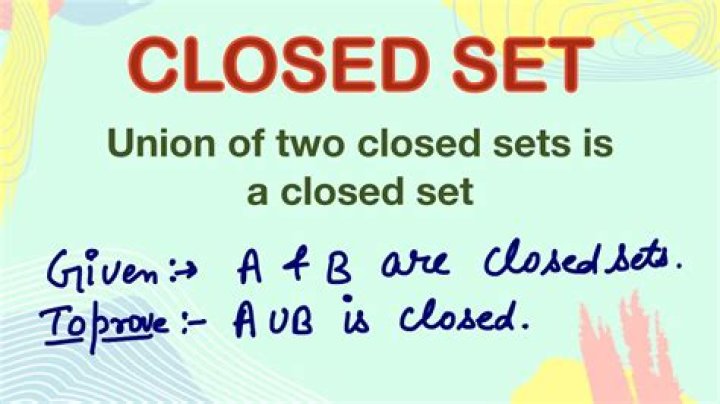
An infinite union of closed sets is a closed set?
Question: {$B_n$}$ \in \Bbb R$ is a family of closed sets. Prove that $\cup _{n=1}^\infty B_n$ is not necessarily a closed set.
What I thought: Using a counterexample: If I say that each $B_i$ is a set of all numbers in range $[i,i+1]$ then I can pick a sequence $a_n \in \cup _{n=1}^\infty B_n$ s.t. $a_n \to \infty$ (because eventually the set includes all positive reals) and since $\infty \notin \Bbb R$ then $\cup _{n=1}^\infty B_n$ is not a closed set.
Is this proof correct? Thanks
$\endgroup$ 46 Answers
$\begingroup$Every subset of $\mathbb R^ n$ is a union of closed sets, namely, the one-point sets consisting of each one of its points.
Yet not all subsets of $\mathbb R^n$ are closed!
$\endgroup$ 5 $\begingroup$Think of the union of the $B_{n} = [1/n, 1]$.
$\endgroup$ 4 $\begingroup$Consider the topological space (subspace of$\mathbb{R}$ (real numbers) with the usual topology given by $\epsilon$-neighborhood) given by $$\{0\}\cup\{\frac{1}{n}:n\in\mathbb{N}_{>0}\}$$ Then, for every $n\in\mathbb{N}_{>0}$ the subset $$\{\frac{1}{n}\}$$is both open and closed, but the countable union $$\displaystyle\bigcup_{n>0}\{\frac{1}{n}\}$$ is precisely the set $$\{\frac{1}{n}:n>0\}$$ which is not closed, for example because $0$ lies in its closure, but not in the set itself.
$\endgroup$ $\begingroup$But since $\infty\notin\Bbb R$ we cannot use it as a counterexample. To see that is indeed the case note that your union is the set $[1,\infty)$, which is closed. Why is it closed? Recall that $A\subseteq\Bbb R$ is closed if and only if every convergent sequence $a_n$ whose elements are from $A$, has a limit inside $A$. So we need sequences whose limits are real numbers to begin with, and so sequences converging to $\infty$ are of no use to us. On the other hand, if $a_n\geq 1$ then their limit is $\geq 1$, so $[1,\infty)$ is closed.
You need to try this with bounded intervals whose union is bounded. Show that in such case the result is an open interval.
Another option is to note that $\{a\}$ is closed, but $\Bbb Q$ is the union of countably many closed sets. Is $\Bbb Q$ closed?
$\endgroup$ 1 $\begingroup$The way I do this is by first proving that the countable intersection of open sets need not be open by this counterexample: $$\bigcap_{\infty}\left (-\frac{1}{n},\frac{1}{n}\right) = \left\{ {0} \right\} $$ Then because a closed set is the complement of an open set we get that the countable union of closed sets need not be closed because $$\left(\bigcap_{i=1}^nA_i\right)^c=\bigcup_{i=1}^nA_i^c\;.$$
$\endgroup$ $\begingroup$In your example, $\bigcup B_i = [1,\infty)$. But this is a closed set so it does not provide a counter example.
Consider $B_n = [0, 1 - \frac{1}{n}]$. Then every $x \in [0,1)$ is in $\bigcup_{n \in \mathbb N_{>0}} B_n$. But what about the end point $1$?
$\endgroup$